
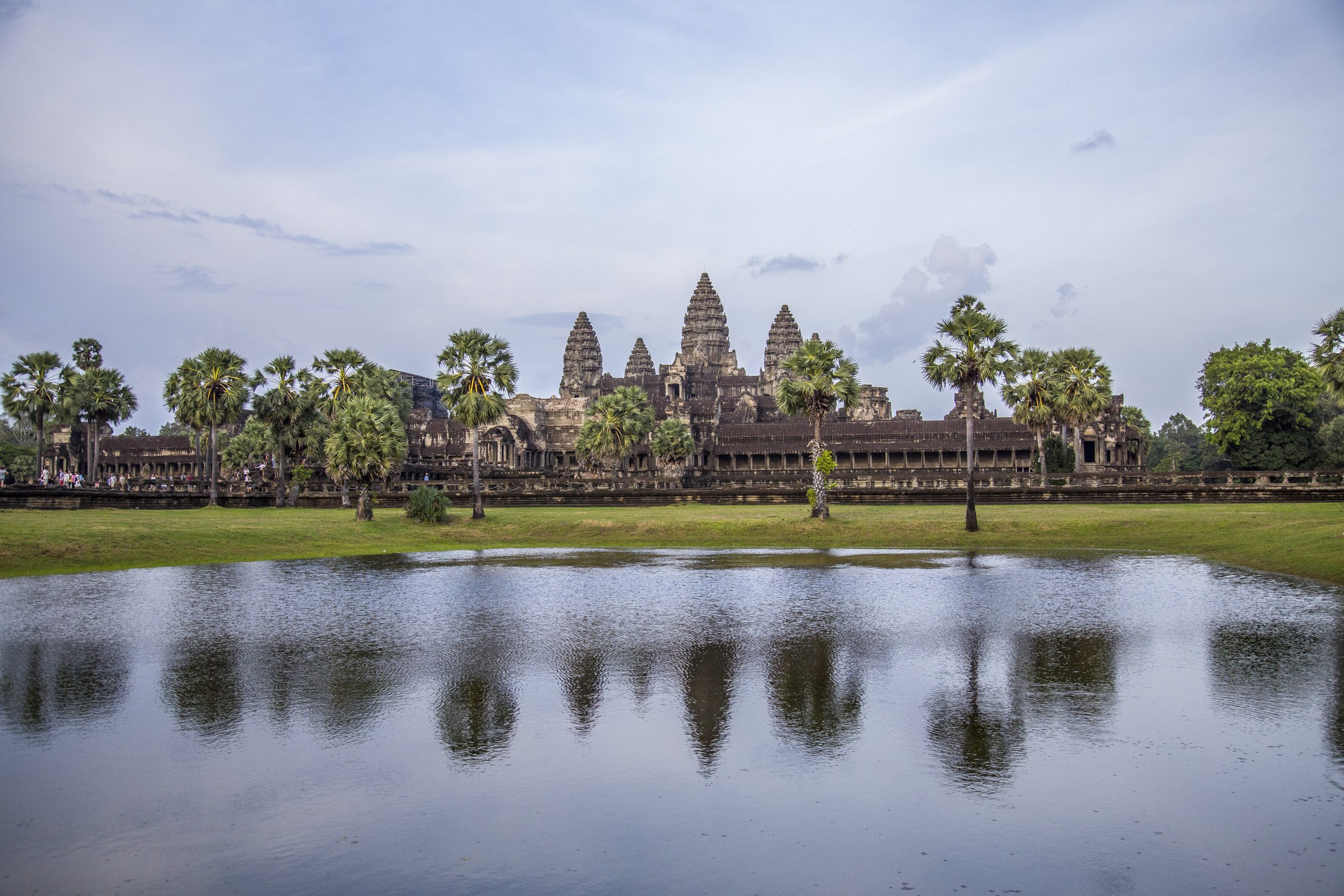
Angkor Wat, the crown jewel of Cambodia, stands as the world’s largest religious monument and a symbol of Khmer brilliance. King Suryavarman II built it in the early 12th century. At first, it served as a Hindu temple dedicated to Vishnu. Later, it transformed into a Buddhist site that still inspires millions.
The design reflects deep symbolism. Its five towers, shaped like lotus buds, represent Mount Meru, the cosmic mountain in Hindu belief. Moreover, the surrounding moat symbolizes the oceans that encircle this sacred peak. The scale is equally astonishing. The complex spans more than 400 acres with galleries, courtyards, and towers arranged with perfect precision. Consequently, Angkor Wat impresses both architects and visitors alike.
Equally stunning are the bas-reliefs carved along the walls. They stretch for hundreds of meters, showing celestial battles, epic tales from the Ramayana and Mahabharata, and daily Khmer life. Furthermore, these carvings were not only art but also a record of culture and belief, preserved forever in stone.
Legends also surround the temple’s construction. Some believe divine beings guided the Khmer builders. Others simply marvel at the skill required to quarry, move, and place enormous sandstone blocks without modern tools. Therefore, Angkor Wat remains both a spiritual and engineering wonder.
Today, the temple continues to inspire devotion and pride. It serves as a place of pilgrimage and appears proudly on Cambodia’s national flag. In addition, travelers from around the world arrive to witness its beauty. Watching the sunrise behind its towers creates an unforgettable moment of history and faith.
Ultimately, Angkor Wat is more than a temple. It blends religion, culture, and artistry into one majestic structure. Thus, it endures as a timeless treasure that continues to inspire every visitor.